Wednesday, 21 September 2011

Utopia NOW!!!!

For years and years now we have looked up to our chosen governments to provide us better living conditions and to help us all realise our own Utopian ideas. Unless in today's society you personally believe in a religion which offers you a sense of heaven after death and that you are currently just on a journey in life to getting there, (which to me appears to be a hopeful and calming thought), most people have lost faith in heaven or believe in hell which i find leads them on a selfish path to destruction. With no believe in heaven causes no real need to be extra caring to other people and no believe in Hell leads to no fear for wrong doing. Since some people have lost faith in God or in our Government, they find it in them selves to create there own utopia with in their own life's. Whether this be through that new car or new bag you have always wanted. Maybe it is that holiday you have always dreamed of or that house in the countryside. What if your utopia is to just provide for your family and give them the best, whatever it is nowadays it all appears to resort back to consumption and self image. We appear so intent in consuming and wasting so much material just to try and create our own Utopian lives.


Even art it self has become an consuming self imaging commodity. from a 20th century avant-garde art movement like Cubism pioneered by Pablo Picasso and Georges Braque, which revolutionized European visual art, and inspired related movements in music, literature and architecture,  to the Young British Artist's of today, one being Damien Hurst and his £50m platinum skull completely covered by 8,601 diamonds. (image below)


What i am trying to say is that by us humans trying to create our own Utopian worlds we have become so very, very selfish and the contradicting part of it all is by doing this we are literally destroying the world we live in to do it. Our need for Utopia is becoming our real Dystopia. Mother Nature is fighting back.

Now What???

So after the enlightenment Era art started to move allot more freely and develop into Romanticisium and further art movements which began in France after Louis XIV's death in 1715. More freedom was allowed, permitting creativity and self-indulgence with in the contence of the art. Utopia had been written by Thomas Moore by now and even though he, himself was a religious man, as was beheaded for his believes, his book was open to any one from different backgrounds. Painting of a Utopian view in these day where still peaceful and romantic but the present of a godly figure was no longer in every utopian image. An example of this is with J. M. W. Turner and his painting, Chichester Canal, Image below. Some artist where producing these beautiful panoramic landscapes of a peaceful, calming nature.


Now because of the enlightenment era the idea of a heavenly or Utopian place was seen as a possible place on earth. But because of the french revolution and the war which followed the idea of a Dystopia or hellish place was also seen as on earth, For example with ThĂ©odore GĂ©ricault’s painting The Raft Of The Medusa, hanging at the louvre, France.(Image below)


So it appears that war had become a new topic in a way and that from this point things appeared to get worse for the human race as we started to become more and more wanting of this utopia or our heaven to exist now on earth. One prime example of a dictator ship that wanted a Utopian world run by himself was Adolf Hitler. This war had once again changed peoples perception of what is or is not utopia. A favouret artist of mine, Henry Moore, was influenced by this war and of human nature its self. His underground tube station drawing i find beautiful. (image below)


As you can see that as time has moved on so to has the freedom to express your self through art and no longer was art about trying to write a biblical story in images but has now moved on to tell a story with the artist own perceptions and emotions.

Moving On

Moving on from the Renaissance period with Bosch to the Romanticism period with the artist William Blake with his writing's of the marriage of heaven and hell and with his imagery (image below), we as a society started to move into the enlightenment era.


It was at this time of the Enlightened Era that philosophers believed that all men were equally as they all possessed reasoning and so had the right to live. This lead to philosophers viewing the church as a sauce of ignorance as they believe God made the earth to watch evolve and develop and that heaven and hell did not existence, life is in the here and now.

During this era the views and concepts helped influence the revolutions that helped shift the balance of power from the church to the people. Even though the philosophers during this time had changed the views of so many people, allowing them to think for freely allowing science to develop, it also develop the beginnings of governments systems but most of them were leading to despotism (the belief of one greater leader). This freedom was great for our culture as a way out of the church constraint's of the church but i believe this was also the beginning in the slow deconstruction of our society thus this Utopian era was to one day become what i now believe to be our current dystopia society.

The Garden

Carrying on the Religious notion of utopia/dystopia being, "Heaven and hell" carried on during the renaissance period (1400-1600) with a well known artist Hieronymus Bosch (1450-1516). Bosch painted a triptych which was a popular standard format for altar paintings from the Middle Ages onwards but which originates from the Greek "triptychos", the word arose into the Medieval period from the name for an Ancient Roman writing tablet. This triptych is called "The Garden Of Earthly Delights," which is oil on wood, sizing 220cm x 389cm and currently lives in Museo del Prado in Madrid. Below image.


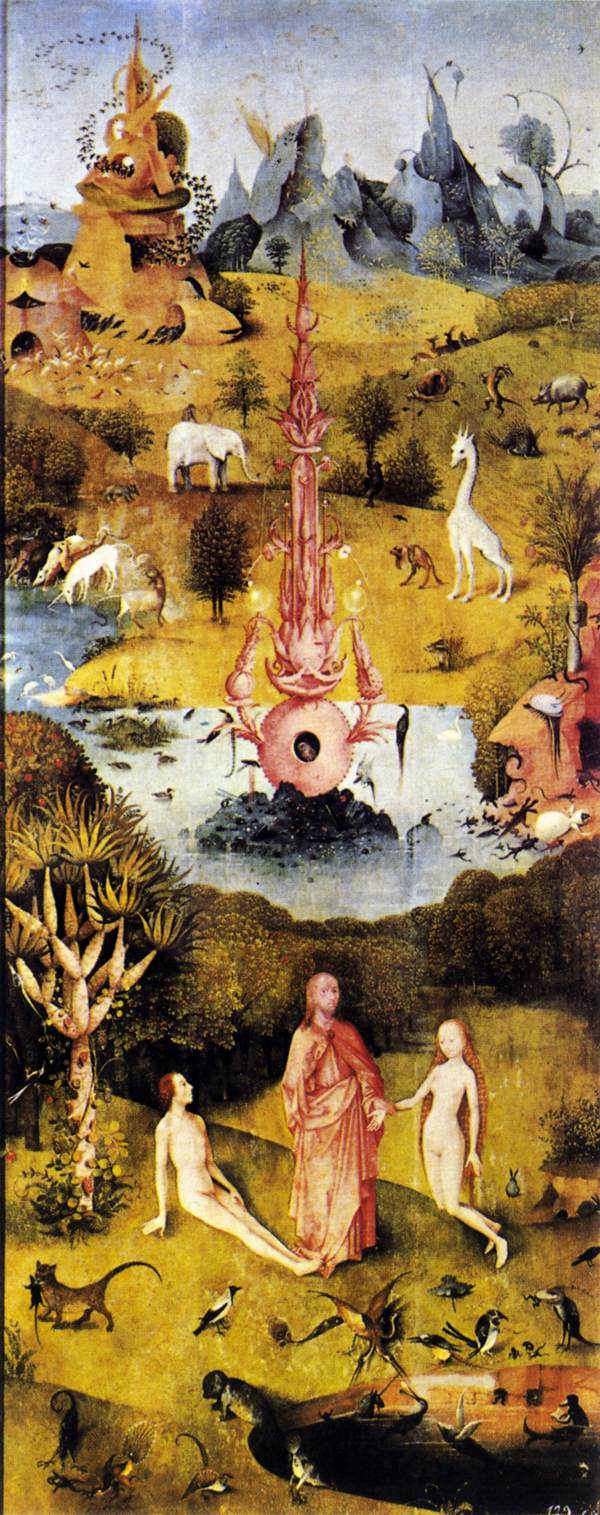
It consist of three panels each with a different story as to tell. The left panel represents heaven where god is standing between what can only be described as Adam and Eve who are surrounded by strange animals and peaceful and serene surroundings. image below.


 The middle panel represents the world in the current time of creating it in the 15th century and to me is very typical of surrealism and Bosch could be seen as one of the first surrealist. When it comes to the happening with in the painting to me it appear to be a collection of mixed behavior. For example you have what appears to be a pool of Innocent girls in the middle surrounded by what could be seen as young lads just sinfully enjoying them self's on horses. In contract there is also a few sceans where a some youths are become sexually interment, so to me there are goings on that could lead to both heaven and hell. Image below


When it comes to the last panel there is no mistake that this is hell, with dark colours and eating of humans, not to mention the gates of fiery hell in the upper right hand Connor. (image below).

Here we see that humans how could of originally enjoyed the passion of being sexual are now in turn being attacked by animal like creatures. I it say to say that in this time period the ideas of heaven and hell were set in stone and were widely the same for every one.

Monday, 19 September 2011

How did they do it??

Carrying on the this theme of Utopia/ Dystopia i am looked into a number of different artist who have created work in response to the concepts. Thomas More, the founder of the word Utopia, created the word from Greek to represent a "perfect place" or a "none place" which has been explored and reinvented in many different areas within our society. For example it can be expressed through, politics, economically or religion. 
Today in this blog i plan to research into the Religious side and how artist have expressed they reflection of the idea of Utopia and Dystopia though their work. During the Romanesque and Gothic period ,1000-1140 AD, the main commission for making art was from the church and at this time in the west it held the most money and power to do so. This being the case most art work was either sculptural with the architecture of the cathedrals or paintings within the Church and bibles. The main Utopian and dystopian thinking was about how to lead a Christian honest life and how to prevail to heaven and avoid hell. This was reflected within the art.


Here above is a piece by an unknown French Romanesque sculpture dated 1125-35 which is a sculpture out of stone above a door way of an Abbey called Church of Sainte-Foy in Conques, France. It represents the gate way to heaven and hell. The left side represents heaven as it appears at the bottom people are being led away by Jesus and above there is an angle shooing away the goblin like figure on the right where people are being subjected to beatings and at the bottom right being feed to a larger beast.

This piece interested me because this image is quite graphic and portrays images that if the church was to recreate them today in a more contemporary manor would shock and upset a lot of people. This piece of art  has been carefully and beautifully made which also represents our views of life during that period. I relate this to my work as i have fondness with contradictions and contrasting images and sculpture and this piece is just that this each side contrasting the ways of after lives Western people believed we would live. If i was to create a piece of work based on this i would make a number of little figures which into days world i would considered to be modern and recreate this scene but with the sins and virtues of our current society.

(insert image of my imitation to come)


Thursday, 15 September 2011

Ideas Begining

After looking at Richard Wilsons piece 20/50 I had the idea of creating some work based on a world that is in a state of equilibrium where nothing is branded and every one shared the same ideas and theories. It would appear all colours and personalities have mixed together and becomes a flat simple grey. It would be ironic as the term "grey area" can normally mean something more complicated. This would give the work a sense of ambiguity.

Practically i would collect everyday items, i.e. fruit, clothes, gadgets or make up, and to cover them in grey paint to take away any branding but to keep the form and shape.


I would use objects that people use to create them selfs as individuals or that they may create self-obsession. I believe that today people in our society are controlled by there need to improve there image or by there need to have a better way of living, this tends to stir us away from the most important things in our life’s. I feel that this constant need to get better technology, better looking homes and clothes will cause us to get more and more in debt and self involved.

The idea of eradicating and simplifying objects to me, is both utopia and dystopian. The utopian effect would be no more unnecessary bulling or jealousy but the dystopia side would be that without variety in life no would produce beautiful art or literature or feel any real love or passion.

Monday, 12 September 2011

Londn

After being in london today i found my mind expanding with different idea and am now needing to focus in more detail what i have found. So to begin i will evaluate a piece i saw in the Saatchii Gallery by the artist Richard Wilson titled 20/50 pictured below.


This piece comprises of a room filled with used sump oil. it is the only permanent installation at the Saatchi Gallery and has been installed in each of the gallery’s venues since 1991. It is Currently on display in Gallery 13 which is a room that was custom built for the piece. Saatchi brought this piece off Wilson after viewing it at Matt's Gallery nearly 16 years ago and feel in love with it.

The inspiration for this work came to wilson during a holiday in the algarve, after staring at a swimming pool he decided for his new piece at Matt's Gallery he wanted to flood the place. The reason he used oil was for it reflective qualities and which gives this piece its name 20/50, after the type of oil used. The work has a walk way running through into it as to allowing the viewer to be surrounded by most sides by the oil to add to its suffocating effects. This was closed when i visited but this did not change the intoxicating (from the fumes) and disorientating experience for me. 

The reason i first fell in love with this peice was because on first inpression you believe you are walking into a empty room or that this peice is about a raised floor, But when the realisation kicks in about it being oil, you gain this wonderful stunned feeling causing you a jaw dropping moment. 
I find the fact wilson has worked with used oil ties in with this idea of recyling materials which i have incorporated with in my own practice. another similarity is the interest of causing the audience a sence of disorientation which he has done so well in this piece. I am also interested how he worked with material to amplify the surrounding architecture. Every time this peice is installed the viewer is drawn into looking closer at their souroundings which i find mesorising.

Richard Wilson him self is a british artist born in islington in 1953 and finds himself draw to the decay of materials. In previous work his is known for cutting wholes into buildings and creating contraptions that make the wall move in a rotating motion, for example image below


He appears to have challenging attitude about the rules of our society and had once said he would roll two  oil drums, on fire, though the windows of a gallery filled with hay. this gives me the impression he is very much into creating chaos and in his own dystopian way.